by Richard Triggs | Sep 13, 2024 | Blogs
By Kace O’Neill | September 13, 2024|6 minute read
Which way for businesses: In-house recruiters or external agencies? – HR Leader
Which Way For Businesses In House Recruiters Or External Agencies
As the war for talent rages on, businesses are forced to make a decision: do they use external recruitment agencies? Or, instead, grow and build in-house recruitment teams to do the job?
Recruitment, recruitment, recruitment. With talent pools tightening and retention strategies constantly evolving, recruitment is a mainstay for an Australian organisation attempting to grow its business outcomes in what has been a volatile economic climate.
HR Leader recently spoke to Richard Triggs, founder of Arete Executive and author of Winning the War for Talent, about how Aussie businesses should navigate the decision of either relying on in-house recruiters or reaching out to external recruitment agencies.
“Over the last 10 years or so, we have seen a significant increase in organisations building their own recruitment teams rather than relying on external recruitment agencies. Especially utilising LinkedIn Recruiter licenses, there is a widely held belief that in-house recruiters can do as good a job as external recruiters for a fraction of the cost,” said Triggs.
Although the trend of Australian organisations building their own recruitment teams has grown substantially over the last decade, the process isn’t all sunshine and rainbows. Instead, it can present common problems that leave managers shaking their heads at the shortlisted candidates. “In many instances, line managers continue to be disappointed with the quality and quantity of candidates presented on shortlists. Why is this so? The primary reason is that there continues to be too high a reliance on advertisements to generate candidates or sending LinkedIn inmails (which largely has the same issues as running advertisements),” said Triggs.
“Great candidates are typically in jobs that they enjoy, they have a good relationship with their boss and peers, and they are relatively well paid. As such, they are not proactively looking for a new job. They are not looking at job ads and are not typically replying to LinkedIn inmails.”
“Passive” candidates is how Triggs describes these workers; it’s a term that has been mentioned frequently on HR Leader. Acquiring the attention of these “passive candidates” requires a constant recruitment campaign, said Triggs. “If you want to attract these ‘passive’ candidates, you need a comprehensive recruitment campaign that should include a strong focus on generating referrals (something most companies put very little attention on), and more importantly, you need to headhunt, especially for senior leadership and/or mission-critical vacancies.”
External agencies often have the resources and protection to produce these comprehensive recruitment campaigns, whereas in-house teams can run into some obstacles.
“Unfortunately, in-house recruiters have some major obstacles to headhunting. Firstly, they can’t maintain the confidentiality of their employer as they need to disclose who they work for,” said Triggs.
“Secondly, because most in-house recruiters are working on a large volume and diversity of vacancies (in many instances 30-plus roles, from receptionist to C-suite), they don’t have the time to headhunt.”
“Finally, most recruiters (in-house and third party) don’t want to headhunt, and lack the training to do so effectively even if they want to.”
Overall, Triggs expresses the common pitfalls that in-house recruiters can fall into and some of the glaring obstacles that they must avoid due to the position in which they reside.
“If your in-house recruiters only rely on advertising, then at a minimum, they MUST put their name and phone number on the advertisement, so that candidates can ring and ask questions. Most ads are just a regurgitation of the position description, offering very limited detail. Quality applicants will want to know more before applying, especially if they currently work for a competitor,” said Triggs.
“If there is no one to ring, they simply won’t apply. Yet I would say that 95 per cent of advertisements run by in-house recruiters have no name or phone number. Think of how this limits your ability to attract top talent? Think of how this affects your employer of choice brand? If your recruiters aren’t putting their name and phone number on the ad, then they are in the wrong job.”
by Richard Triggs | Sep 11, 2024 | Blogs, Uncategorized
Over my 20-plus years as an executive recruiter, it has been interesting to watch the evolution of the debate around diversity in the workplace, especially at a senior executive level. What was once regarded as ‘nice to have’ has now become in many instances mandatory. On multiple occasions, we have been engaged by ASX100 companies specifically to headhunt women for key appointments to meet a gender diversity target.
Now diversity extends far beyond just gender to include sexual orientation, ethnicity, age, people with disabilities, and increasingly people from an Indigenous background (especially at board level). I’m certainly a big advocate for diversity and highly encourage our clients to step beyond their traditional avatar of what makes a good employee. It’s also essential that there is a commonsense approach to ensuring that even when hiring for diversity, the appointed candidate is equally well credentialed based on merit. These people definitely exist. The challenge becomes how to find and attract these people to your organisation. Here’s a real-world example:
A few years ago I was at a gender diversity debate dinner, one of only a handful of men in a room surrounded by at least 150 women. It would be fair to say there was a lot of heated commentary about the ‘patriarchy’, the ‘glass ceiling for women’ and similar statements. So I decided to do a bit of an investigation. In the previous month, we had recruited four C-suite roles (CEO, CFO, COO and the like), three of which were for not-for-profits. In every instance, the client had specifically said that they would love to employ a woman.
Across the four roles, we had 800 unique applicants to our advertisements. What percentage of these do you think were women? Seven per cent! Fortunately, we are headhunters, so we are not reliant on ad response to fill our vacancies. If women truly want these opportunities yet aren’t applying, what’s going on? This is definitely a generalisation, but often if a female candidate reads an advertisement that calls for ten criteria and she believes she only has seven or eight, she often won’t feel it’s worth applying as she is underqualified. On the other hand, if a man reads the same advertisement and believes he only has three, he’ll think he’s absolutely the best candidate for the job! (Once again, yes, I know I’m generalising; however, it is a common scenario.)
What’s the answer? If you legitimately want to hire for diversity, you need to accept that you are very unlikely to get the right quality and quantity of candidates from advertising alone (whether you’re seeking gender diversity or otherwise). You need to headhunt these people because they are generally in higher demand, not actively looking, and may be less likely to apply (as mentioned above). Hiring for diversity is an excellent thing. Hiring exceptionally talented people who have proven key achievements and transferable skills is also a great thing. Don’t fall into the trap of hiring people purely to achieve a diversity target.
Employ the best person, who also happens to bring diversity to your team. Hiring policies that include both attributes, versus one or the other, is where the gold lies. Do this consistently and you will have an amazing business.
Published Bsale Magazine | Expert Advice and Insights on Business Sales
Author: Richard Triggs
www.areteexecutive.com.au
Author of* *Winning the War for Talent.
by Richard Triggs | Sep 9, 2024 | Blogs
By Richard Triggs published in The Sydney Morning Herald and The Age on Saturday.
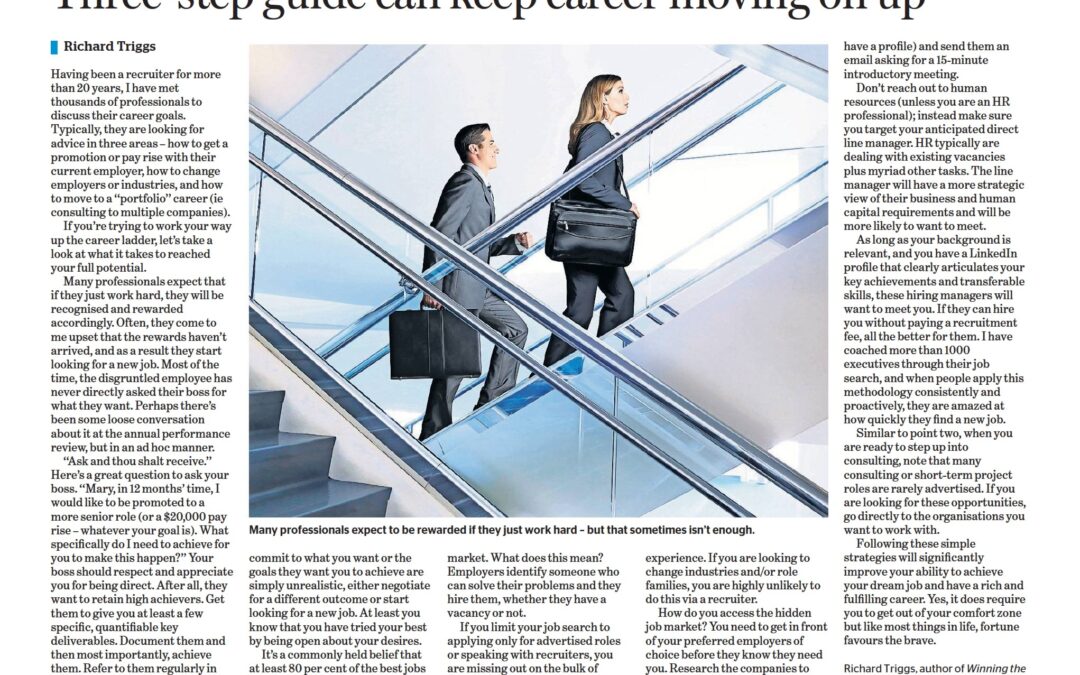
Having been a recruiter for more than 20 years, I have met thousands of professionals to discuss their career goals. Typically, they are looking for advice in three areas – how to get a promotion or pay rise with their current employer, how to change employers or industries, and how to move to a “portfolio” career (i.e. consulting to multiple companies).
If you’re trying to work your way up the career ladder, let’s take a look at what it takes to reach your full potential.
Many professionals expect that if they just work hard, they will be recognized and rewarded accordingly. Often, they come to me upset that the rewards haven’t arrived, and as a result, they start looking for a new job. Most of the time, the disgruntled employee has never directly asked their boss for what they want. Perhaps there’s been some loose conversation about it at the annual performance review, but in an ad hoc manner.
“Ask and thou shalt receive.”
Here’s a great question to ask your boss: “Mary, in 12 months’ time, I would like to be promoted to a more senior role (or a $20,000 pay rise – whatever your goal is). What specifically do I need to achieve for you to make this happen?”
Your boss should respect and appreciate you for being direct. After all, they want to retain high achievers. Get them to give you at least a few specific, quantifiable key deliverables. Document them and then most importantly, achieve them. Refer to them regularly in your meetings and keep your boss updated on your progress.
Of course, if your boss can’t commit to what you want or the goals they want you to achieve are simply unrealistic, either negotiate for a different outcome or start looking for a new job. At least you know that you have tried your best by being open about your desires.
It’s a commonly held belief that at least 80 per cent of the best jobs are never advertised or recruited in the open job market. They are recruited through the hidden market. What does this mean? Employers will typically find someone who can solve their problems and they hire them, whether they have a vacancy or not.
If you want your job search to be effective, don’t just rely on advertised roles or speaking with recruiters, you are missing out on the bulk of the opportunity. Also, most recruiters will only prioritize candidates with very specific experience. If you are looking to change industries and/or role families, you are highly unlikely to find this via a recruiter.
How do you access the hidden job market? You need to get in front of your preferred employers of choice before they know they need you. Research the companies to identify who your role would most likely report through to. Connect with them on LinkedIn (most will have a profile) and send them an email asking for a 15-minute introductory meeting.
Don’t reach out to human resources (unless you are an HR professional); instead, make sure you target your anticipated direct line manager. HR typically are dealing with existing vacancies plus myriad other tasks. The line manager will have a more strategic view of their business and human capital requirements and will be more likely to want to meet.
As long as your background is relevant, and you have a LinkedIn profile that clearly articulates your key achievements and transferable skills, these hiring managers will want to meet you. If they can hire you without paying a recruitment fee, all the better for them. I have coached more than 1000 executives through their job search, and when people apply this methodology consistently and proactively, they are amazed at how quickly they find a new job.
Similar to point two, when you are ready to step up into consulting, note that many consulting or short-term project roles are rarely advertised. If you are looking for these opportunities, go directly to the organisations you want to work with.
Following these simple strategies will significantly improve your ability to achieve your dream job and have a rich and fulfilling career. Yes, it does require you to get out of your comfort zone but like most things in life, fortune favours the brave.
Richard Triggs, author of Winning the War for Talent, is founder and CEO of Arete Executive, an executive search and recruitment company.
—
Published in The Sydney Morning Herald and The Age on Saturday.

by Richard Triggs | Aug 30, 2024 | Blogs
The world is very much at the tail end of the Covid-19 pandemic. Business optimism is high (regardless of what you hear in the media), organisations are growing, and candidates are back to being active in the market and looking for new opportunities.
There has definitely been a cultural shift in the way people are looking at their careers and the way they wish to be engaged with their employers. Working from home, working part time, telecommuting and contracting versus permanent employment are not new phenomena. However, the zeitgeist has definitely changed as more and more people want these alternate arrangements rather than the traditional Monday-to-Friday, nine-to five employment model.
These trends were definitely happening pre-Covid, especially with improving internet speed and availability, virtual meetings over Zoom and Teams, and other technology. It’s just that the pandemic and resulting lockdowns and travel restrictions greatly accelerated candidates’ desire for change. However, the fundamental recruiting environment remains largely the same as it was 20 years ago when I first started my recruitment career, especially the excuses for poor hiring and retention, so let’s dispel two of these right from the get-go.
Myth: the war for talent
When I first started working in the recruitment industry in 2002, I joined TMP Worldwide (now known as Hudson). At the time they were the biggest recruitment company in the world, and I was excited about joining such a prestigious brand. I clearly remember, in my very first days of induction, being introduced to this term of doom and gloom, ‘the war for talent’, designed to spread fear among employers and to lower their expectations regarding the quality of candidates they would see on a shortlist presented by us.
It’s not dissimilar to a real estate agent manipulating homeowners into accepting a lower price for their house, because ‘it’s a buyer’s market out there’ so the owner should be grateful to receive an offer at all. It amazed me that recruiters basically sold a service by pre-emptively conditioning employers to be underwhelmed. More importantly, that’s exactly the level of service they then delivered. On the other hand, I believed (and still do) that as recruitment professionals, we must be able to guarantee to deliver outstanding shortlists, which requires a headhunting approach. At my firm Arete Executive, unless we deliver a shortlist within 20 working days that our client is delighted to interview, we offer to refund our client their retainer. If we say we can deliver the result, we should hold the risk of non-performance.
It’s 20 years later and I still hear about the ‘war for talent’ on an almost daily basis, from CEOs and business owners, HR managers and internal and external recruiters. Quite frankly, it’s a load of BS and the fact that it is perpetuated is just an indication of how dumb and lazy most people charged with recruitment are.
Rather than working harder and smarter to attract outstanding candidates, it’s so much easier to just blame the market and accept mediocrity. Let me give you a couple of examples. Earlier this year my recruitment company was engaged by one of the biggest mining companies in the world to recruit for them an HR manager in regional Australia (I won’t tell you their name, however if you think about the top three Australian global mining companies, it’s definitely one of them).
Now this particular mining company had this role vacant for close to eight months, and the fact it remained vacant was causing a lot of distress to the line manager as it was significantly impacting their ability to do their job and deliver results well. Yet the head of internal recruitment, who was responsible for finding candidates and filling the role, had not delivered on what was a fairly simple brief, even after such a long period. The excuse – ‘it’s a war for talent’ – was there were no suitable candidates in the region, or who wanted to move to the region. They had essentially given up, while still paying lip service to some continued sourcing activity taking place.
Eventually, the line manager was given permission to engage us to deliver a suitable shortlist, which we were able to do in less than two weeks, that resulted in a very fast and successful placement. Why were we able to get such an immediate and positive result? Because unlike the internal recruiter who simply placed a bland and uninspiring advertisement on Seek and sent a few lacklustre InMails on LinkedIn, we undertook a comprehensive sourcing strategy that left no stone unturned.
Myth: the great resignation
How many times have you heard this phrase in the last couple of years, especially in our post-Covid world: ‘It’s not my fault we can’t retain people – it’s the great resignation’? It’s as if everyone drank the Kool-Aid while working from home, and woke up hating their boss, hating their employer, hating their profession, and all wanting to quit and join the circus.
‘Especially the younger generation, who want the world and show no loyalty to their current employer,’ complains the older senior executive while talking to me about looking for a new job and an extra $100k. Ahhh, the joys of hypocrisy. In 2010, a global poll conducted by Gallup uncovered that of the world’s one billion full-time workers, only 15 per cent of people were engaged at work. That means an astronomical 85 per cent of people were unhappy in their jobs.
The average professional job tenure in Australia from 2000 to 2022 has consistently sat at around 3.0 to 3.5 years. This means that people change employers roughly every three years. A recent PwC report on the ‘great resignation’, ‘What Workers Want: How to win the war on talent’, found that 38 per cent of Australian workers intend to leave their current employer during the next 12 months. Which is, guess what? A tenure of about 3.0 to 3.5 years. So the more things change, the more they stay the same.
There is no great resignation, it’s just media doom and My simple explanation is this. During Covid there were a lot of people who wanted to change jobs, however chose not to do so because they felt the risk of change at that time was too high. ‘What if I change jobs and then get Covid, but don’t have any accrued sick leave or annual leave?’ Or, ‘What if I change jobs and then my new employer is negatively impacted by Covid, and I end up being made redundant?’
So they stayed in jobs longer than they would have normally because it was a safe harbour in a storm. Now that Covid is largely behind us, these people are resigning for new opportunities. Covid was just a bottleneck and now the employment market has returned to normal. The statistics prove this.
I can honestly say I have not had a single regrettable loss from my business in over five years. Likewise, I know countless CEOs and business owners who have been able to retain all their top performers both during and post Covid. They have invested time and money into building their brands as Employers of Choice, and in maintaining a performance-based culture that encourages and rewards exceptional individual and team performance.
Just like the war for talent, the great resignation is a crappy excuse for poor leadership. The great news is that you are going to learn how to build and maintain a culture to not only attract high performers to your businesses, but also to retain them for much longer than industry averages.
Other myths and clichés
There are so many other myths around recruitment, leadership and retention that I could write a whole book on this subject. Then there are the clichés that seem to be repeated in every business book, such as, ‘strategy eats culture for breakfast’ (Peter Drucker), or ‘start with why’ (Simon Sinek)’, or even ‘courage over comfort’ (Brené Brown). In their time, these ideas were thought-provoking and challenged some old business paradigms, but they
just seem a bit naff now through endless regurgitation (a bit like Rick Astley’s Never Gonna Give You Up – thank you Ted Lasso for being such an awesome TV show). How about we just learn some simple tools and then go out and kick some butt?
Written by Richard Triggs for

To view original article The war for talent, the great resignation and other myths – CEOWORLD magazine